Spotlight on Korean Studies in K-12 Schooling

Join us as we explore the insights gained from educators who have advanced long-standing Korean language and Korean educational programming in their schools. Learn how the creative Korean programming our speakers developed evolved over time. Bruce Ballard, Professional Development Specialist at Bronx Charter School for Better Learning, shares his experience with elementary school programming. Jisun Kwon and Kleio Park, Korean language teachers at Francis Lewis High in Queens New York, address public high school courses and events. Come hear their tips on best practices and working within the school and community.


Sign up here to receive the viewing link


Spotlight on Korean Studies in K-12 Schooling
Monday, May 17, 2021 | 4 PM (EDT)

The Korea Society
350 Madison Avenue, 24th Floor
New York, NY 10017


ABOUT THE SPEAKERS:

Bruce Ballard has over forty years’ experience in teaching language and communication skills, writing, pedagogy and cross-cultural skills in over a dozen countries. He began his professional career as a Peace Corps volunteer in South Korea training Korean middle school teachers in Weon Ju, Kang Weon Province and teaching at Jeon Buk National University in Jeonju, North Cholla Province. After returning to the U.S. Bruce received a doctorate in applied linguistics from Teachers College Columbia University. He introduced Korean language and studies programming over 15 years ago in a charter elementary school with a non-Korean population in the Bronx, New York.

Jisun Kwon has 11 years of Korean language teaching experience at the elementary, middle, and high school levels in Queens, NY. She has been teaching Korean for non-native and native students at Francis Lewis High School since 2013 and has served as a Korean Language Other Than English Exam developer as well as a lead instructor for Korean STARTALK summer program at Francis Lewis High School. Additionally, she is currently developing the curriculum and teaching Korean language and culture for heritage students at the Korean School for Global Leaders in Queens and serves as an assistant director. Prior to 2013 she taught Korean for non-heritage students at Middle School 8 in New York.

Kleio Park is a New York State certified Korean language teacher. Since 2013 she has taught novice, intermediate, and advanced level classes for non-heritage and heritage students and in 2020 attained OPIc rater certification. In the 2020-2021 academic year she successfully led the Year 4 Korean Program at Francis Lewis High School, in which non-native students were awarded the biliteracy seal for the first time in New York State. She creates fun and culturally relevant posts to @speedykorean on Instagram to promote Korean literacy.


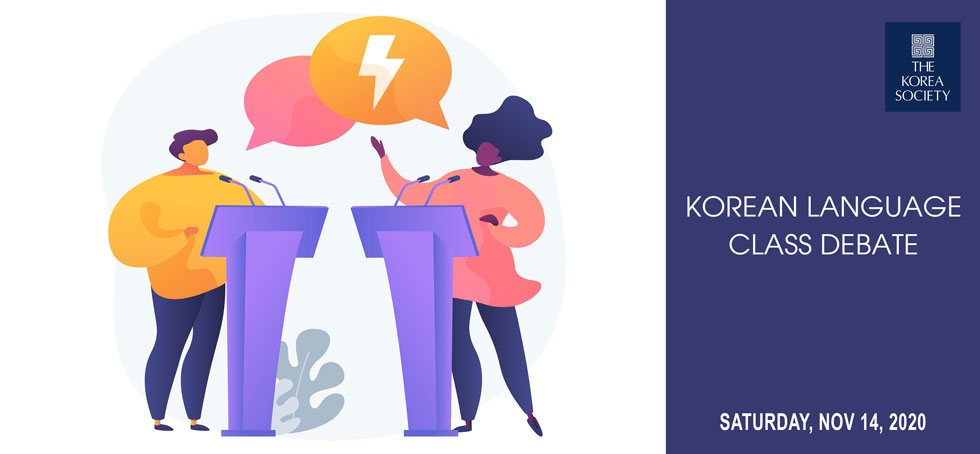
Korean Language Class Debate

At the request of KLP advanced language skills students, the Society has launched a Debate Series. In November, the KLP hosted its second Korean debate that focused on Korean pop culture. Parasite, the Academy Award-winning movie for best director and best picture, was chosen as the topic with discussion focused on social inequalities and their consequences as well as why inequality matters in Korean society now. The debate, conducted entirely in Korean, was moderated by a Korean language instructor who provided feedback on participants’ language use.


Korean Language Class Debate

Saturday, November 14, 2020

The Korea Society
350 Madison Avenue, 24th Floor
New York, NY 10017


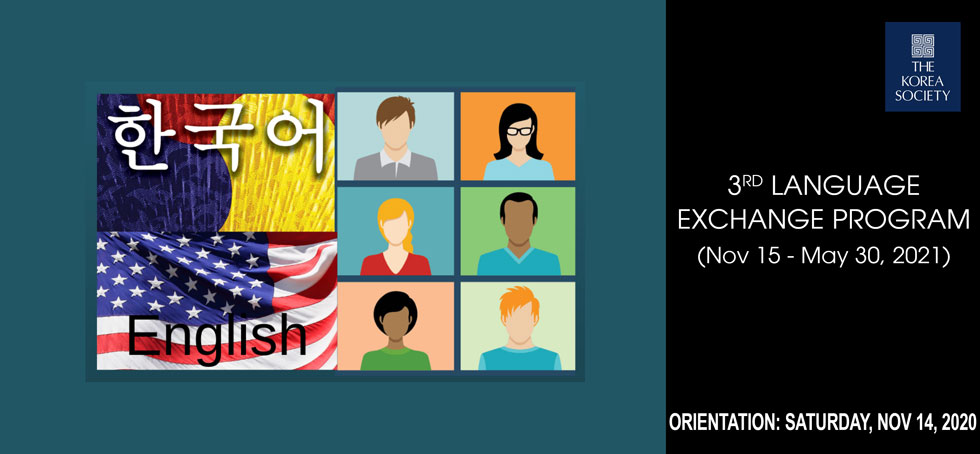
3rd Language Exchange program

In November 2020 the Society not only launched its 3rd Language Exchange Program, which matches native Korean and English speakers for conversation practice but added a new global element. This year, 33 students from Korea University and Ewha University were paired as conversation partners with the Society’s Korean Language Program (KLP) students. This is the first time that we attempted to match students in Korea with KLP students in the US. Additionally, it is the first time the Exchange has been offered virtually. Partners meet virtually through May 2021 using a KLP hosted chat app; staff regularly consults with partners to ensure valuable experience and language skills are being gained.


3rd Language Exchange program

November 15, 2020 – May 30, 2021
ORIENTATION: Saturday, November 14, 2020

The Korea Society
350 Madison Avenue, 24th Floor
New York, NY 10017


PROJECT BRIDGE OVERVIEW

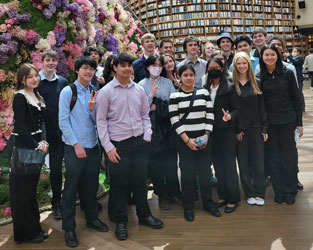
2023-2024 Los Angeles, Montana, and New York Youth Ambassadors at Gyeongbuk Palace in Seoul

PROJECT BRIDGE OVERVIEW

Project Bridge, whose name captures the goal of reaching across ethnic and cultural divides, aims to help young people develop insights and skills needed to “bridge” the gaps between people of divergent cultural heritages. By fostering greater intercultural awareness and understanding, it empowers the youth ambassadors to view social and cultural differences as a pathway – not a barrier – to exercise their responsibilities as emerging young leaders in an increasingly interconnected and richly diverse world while educating them on the long-standing and close relationship between the peoples of Korea and the U.S.

U.S. Partners:
The Korea Society in New York developed the program in response to the 1992 Los Angeles Uprising that erupted on April 29 (Sa-I-Gu in Korean). The first delegation of urban “Youth Ambassadors” was sent to the Republic of Korea in 1993 on a program named Kids to Korea. Early in its inception the Society partnered with Pacific Century Institute in Los Angeles to further hone and advance the program. And, 27 years later in 2019 Project Bridge welcomed a new demographic and partner, The Maureen and Mike Mansfield Center at the University of Montana in Missoula, bringing a diverse rural and Indigenous perspective to the program.


Students:
Open to junior and senior public high school students in New York and Los Angeles, and a range of students in Montana, the program attracts applications from students of different socioeconomic and ethnic backgrounds. Through a highly selective application process eight students from Los Angeles, eight students from New York and eight students from Montana are selected each year to become Youth Ambassadors.


Curriculum: 
The Program has evolved into an academic year-long program in which students, using Korea as a case study, cultivate their understanding of race and crosscultural relations and hone their leadership and intercultural competence skills. Students participate in bi-monthly workshops offered both in-person and virtually. They undertake a 10-day study tour to the Republic of Korea. Finally, the Program culminates in community presentations and a graduation ceremony.

Workshops: 
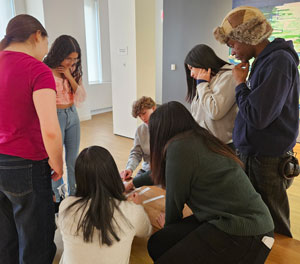
In the bi-monthly workshop students are introduced to a wide range of topics spanning Korean pre-modern and modern history, the Korean war, education in Korea, the arts and cuisine as well as cultural values. They explore current events, U.S. and regional relationships, and the economic factors that led to the ‘Miracle on the Han’. Additionally, they investigate race relations in the U.S., specifically the 1992 Sa-I-Gu incident, otherwise known as the Los Angeles Uprising, the impetus for creating the Program. Outside experts frequently lead lively and informative discussions both in-person with the smaller regional groups and via Zoom with the entire cohort. Students also receive Hanguel language training and etiquette coaching along with preparation for the study tour.
Study Tour: 
The ten-day spring Study Tour to Korea, a highlight of the program, provides youth ambassadors with a powerful experience to see Korea first-hand and meet Koreans in their own environment. It involves a geographic breadth of exposure to many people, activities, and places in Korea of historical and social significance.  During this all expenses paid tour students have abundant opportunities to engage with Korean high school and university students, instructors and professors, corporate leaders, government officials, Buddhist monks and many others as they travel around the country experiencing both city and rural life. Throughout the tour they gain a deeper understanding of the Korean people as well as the unique and close relationship between the U.S. and Korea.

Community Presentation: 
The Program culminates in early summer when the youth ambassadors share their newly acquired knowledge and insights about Korea with their families, friends, teachers, and the greater community. These community presentations are open to the public and precede a graduation ceremony. These Project Bridge “graduates” join an alumni group that now numbers over 400.

Sponsors: 
It is only with the expert guidance and generous hospitality of our Korean hosts and sponsors that we have been able to sustain the Project Bridge Program over these many years. Through this support the Korea Society, The Pacific Century Institute, and The Mansfield Center can work with young people to continue to “build bridges” between our two nations. The time students spend with sponsors enhances the invaluable lessons of their Korean experiences and the fond memories of Korea that will endure for a lifetime. Fore Information about Sponsors, please click HERE.

2025 Supporting Sponsors and Sites Visited by Youth Ambassadors

Corporations, Businesses, Government
* Center for a Unified Korea Future
* Chong Kun Dang (CKD) Kochon Education Foundation
* HD Hyundai
* Hyundai Motor Company
* Jeonbuk International Cooperation Agency (JBICA)
* Korean Air
* Korea Foundation
* Korea International Trade Association (KITA)
* National Institute for Unification Education
* POSCO
* Korea IPTV Broadcasting Association
* United Nations Command Military Armistice Commission

Educational Institutions
* Ewha Womans University (Seoul)
* Jeonbuk Foreign Language High School (Gunsan)
* Poongsan High School (Andong)
* POSTECH University (Pohang)

Historical and Cultural Sites
* COEX (Seoul)
* Dosan Sewon Confucian Academy (Andong)
*DMZ
* Gyeongbokgung Palace (Seoul)
* Gyeonggijeon Shrine (Jeonju)
*Hahoe Mask Museum (Andong)
*Hahoe Village (Andong)
* Jeonju Handicrafts Experience Center
* Korean Traditional Cultural Center (Jeonju)
* Markets: Insadong, Mangwon, Mapo and
              Myengdong (Seoul)
* Metropolitan Museum of Art (NY group)
* Pohang Space Walk
* Seonunsa Temple Stay (Gochang-gun)
* Tumuli Park & Daereungwon Tombs (Gyeongju)

 Project Bridge

If you want to be contacted when our next Project Bridge Youth Ambassador competition opens or if you have a question, please
click here.

 

2018-2019 NYC PROJECT BRIDGE YOUTH AMBASSADORS COMMUNITY PRESENTATIONS

2018-2019 NYC PROJECT BRIDGE YOUTH AMBASSADORS COMMUNITY PRESENTATIONS

Aidan Lewis

 
High School for Math, Science and Engineering
 

Traditional Korean Music and Dance


Frances Ferreira

 
Vanguard High School
 

Premodern Korea: Social Classes


Frances Ferreira

 
High School for Environmental Studies
 

Religion and Philosophy in Korea


Jaylen Campbell

 
Brooklyn Technical College
 

Government and Politics


Jesse Weinstein

 
Hunter College High School
 

Korean War/DMZ


Joya Debi

 
Hunter College High School
 

Korean Economy and Development


Khalimah Choi-Owens

 
Fiorella H. LaGuardia High School
 

Gender Roles in Korean Society


Simon Kresberg

 
School of the Future
 

Education in Korea


2019-2021 NYC PROJECT BRIDGE YOUTH AMBASSADORS

2019-2021 NYC PROJECT BRIDGE YOUTH AMBASSADORS

Britney German

 
Long Island City
High School Queens
  I entered Project Bridge as a senior at Long Island City High School in Queens and in fall 2020 started at Mercy College. I was born in New York and went to Mexico when I was 3, living with my mom and two older brothers for about 4 years before returning to the US.

I am active in my church and the community services it provides. And enjoy learning languages and watching documentaries about ancient life, or anything that involves archaeology and paleontology. In the future I hope to become a veterinary technician, archaeologist, or be involved in deaf studies.


Chelsea (Zi) Yan

 
Stuyvesant High School Manhattan
  Born in Xiamen, China, I received primary education until I was 10 in a Chinese school that highly valued the principles of Confucianism. I am fluent in both Mandarin Chinese and English.

Since moving to New York for high school, I have enjoyed participating in many extracurriculars in diverse fields such as entrepreneurship and social activism. I founded BabyBumps, a company aiming to create a new, more environmentally sustainable form of maternity wear products that allows using a special zipper design. I also founded Redefy Stuyvesant, a chapter of the international nonprofit organization that seeks to empower schools with resources and information to be more inclusive.


Elvis Dominguez

 
MLK Law & Advocacy for Community Justice High School Manhattan
  I was born and raised in New York and entered Project Bridge as a senior in MLK Law and Advocacy for Community Justice High School in Manhattan. In fall 2020 I started at Hunter College, CUNY.

I am the president of the MLK Video Game Club and the leader of MLK gaming team, The Seven Deadly Gamers. I enjoy drawing and writing a lot, and in my spare time I read manga or watch anime. I indulge in philosophy, learn programming and do some coding when I get the chance, too.


John Lohier

 
Hunter College High School Manhattan
  I live in Park Slope, Brooklyn and play soccer and run track for my school. I am also on the Model UN team. I am very interested in government, especially foreign relations. Although I have no idea what I want to do in the future, I hope it ends up being something enjoyable and fulfilling!

Josh Senior

 
Brooklyn Technical High School
  I live and study in Brooklyn and am an avid and cognizant global-environmentalist who has a deep interest sustaining arctic and tropical habitats for plants and animals. I am also a member of my school’s debate team, band ensemble, varsity basketball team, and National Honor Society.

Culture also shapes my character. With both parents being born in Jamaica, my Caribbean background works in tangent with my American roots.


Katherine Fernandez

 
Staten Island Technical High School
  While I live in Brooklyn, my high school was in Staten Island Technical High School. In fall 2020 I started my undergrad studies at Cornell University pursuing engineering. Since middle school I have participated in STEM programs such as Girls Who Code and GOALS for Girls at the Intrepid (Naval) Museum. I recently ended an internship at the Intrepid Museum as part of a STEM Entrepreneur group where I will help create a business plan and viable product.

For the past nine years I have played the clarinet. In high school I joined my school’s marching band. I am also interested in art and hope to record everything that happens this coming year in my bullet journal.


Kayla Leung

 
High School for Math, Science and Engineering Manhattan
  I am an active volunteer both at my school and in the Girl Scouts. I also am on the Girls Varsity Soccer and Basketball teams and my travel soccer team.

Growing up in NYC has shaped who I am by providing me numerous opportunities to explore my interests, primarily in the STEM areas. I have conducted research at Mount Sinai Hospital over the summer. My hobbies include learning new languages and listening to podcasts.


Michelle Chan

 
Brooklyn Technical High School
  I have lived in New York City my entire life. I am passionate about STEM fields and am currently concentrating in software engineering.

Additionally, I have been a Girl Scout since second grade and have interned at the Girl Scouts of Greater New York Council.

I enjoy interior designing, and started my own interior design club at my school. I have many hobbies which include drawing, reading, and listening to music.


Osbani Garcia

Group Leader

 
Claremont International High School Bronx
  I grew up in a small town in Mexico until the age of 12 when I moved back to New York City to the diverse neighborhood of Jackson Heights, Queens. I attended the Flushing International High School (FIHS) and in 2008 I was fortunate to be a Project Bridge Youth Ambassador.

I am now an educator and feel honored to have come full circle and able to give back to my community and once again be part of Project Bridge, this time as a group leader and also a student as one never stops learning.

I am humbled and honored to help lead a group of amazing Youth Ambassadors whose leadership and initiative will help them continue to grow as amazing leaders who bring cultural and social unification to their communities.


Designing and Adapting Korean Language Instruction for Virtual Delivery

Many language programs and instructors have needed to quickly change from in-person to online instruction modes this year. If you are looking for ways to improve your delivery, join us to explore tools and best practices for virtual classroom set-up and management. Dr. Sang-Seok Yoon, Associate Professor of Instruction and Korean Language Coordinator at the University of Iowa’s Asian & Slavic Languages and Literatures Department, and Dr. Bumyong Choi, Senior Lecturer and Korean Language Program Coordinator at Emory University’s Department of Russian and East Asian Languages and Cultures, share their expertise on designing and adapting Korean language instruction for the online classroom. Facilitating a Q&A with the speakers is Dr. Joowon Suh, President of the American Association of Teachers of Korean (AATK) and Senior Lecturer in the Department of East Asian Languages and Cultures and Director of the Korean Language Program at Columbia University.


Designing and Adapting Korean Language Instruction for Virtual Delivery
PREMIERES: Wednesday, September 30, 2020

The Korea Society
350 Madison Avenue, 24th Floor
New York, NY 10017


Project Bridge 2019-2020 Application Announcement

DEADLINE: Friday, October 11, 2019 

Prospective Youth Ambassadors who are juniors or seniors in a New York City public high school are invited to apply for Project Bridge, an intercultural youth leadership and intercultural awareness program that advances the ability of its participants to understand and respect other cultures. The goal of the Program is to “bridge” the gap among cultures through cultural awareness and leadership training. It aims to cultivate future community leaders and introduce them to U.S.-Korea relations, with an emphasis on cultural and racial sensitivity and a firm understanding of Korea.

In conjunction with the Los Angeles-based Pacific Century Institute, the Korea Society coordinates this academic year-long program for public high school students. Originally created in response to the 1992 Los Angeles riots, the Program selects a total of 16 student Youth Ambassadors and two educator group leaders from New York City and Los Angeles.

The Program offers many exciting opportunities for its Youth Ambassadors to build leadership skills and intercultural competence, improve their public speaking ability and grow their personal and professional networks. Students engage in bi-monthly educational workshops on topics such as Korean history, language, modern society, and U.S.-Korea relations, as well race relations in the U.S., which are led by topic experts. A key element of the Program is a collaborative research project with their Los Angeles counterparts. Notably, the capstone event is an all-expenses paid ten-day study tour to the Republic of Korea. In the past, Youth Ambassadors have visited Korean high schools, universities, government ministries, businesses, museums and have experienced a home stay with a Korean high school student as well as an overnight Buddhist temple stay. Following the tour, students conduct a community presentation, sharing insights gained. Throughout the program, students meet with diplomats, government officials and business leaders.

Now in its 27th year, Project Bridge is expanding its outreach to a new demographic of primarily rural and tribal youth. The Mansfield Center at the University of Montana in Missoula has joined as the newest Project Bridge partner. Founded in 1983, its mission is to promote U.S. relations with Asia and ethics in public affairs. It is named for Mike Mansfield, a former U.S. senator and Ambassador to Japan, who left an enduring mark on U.S. international diplomacy. The Center has strong youth international exchange programs with Japan, China, Thailand, and Cambodia. This will be their first youth exchange with Korea; students and staff will be fully integrated into the program.

We encourage eligible New York public high school student to apply for this unique program!

APPLICATION MATERIALS

Missoula, Montana area applicants, please visit this link for application forms.

Los Angeles applicants, please visit this link for application forms.

Applications must be postmarked by Friday, October 11, 2019 and mailed to:

Linda Tobash
The Korea Society
350 Madison Avenue 24th FL
New York, NY 10017
 

Program Schedule:

DEADLINE: October 11, 2019 | Application Postmark Deadline

November 2019  | Announcement of Finalists

April 2020  | Study tour

For more information, please contact Linda Tobash or call 212-759-7525 ext. 311 .


A Brief History of Han

The term han is difficult if not impossible to translate into English – at least not in a word or two. Words such as “rage” or “deep sorrow” are not sufficient to capture the complex of emotions that it evokes. Yet it is something that Koreans can readily identify when they see it. This talk examines some historical examples of han taken from both literature and real-life events. They will include the Great Revival Movement of 1907; the death and funeral of Sunjong, the last Korean emperor, in 1926; and both early-20th century and postwar literature. Through this examination, I hope to provide a better understanding of han – and of why generation after generation of Koreans seem to be able to feel it so acutely.


Tickets

 
The Korea Society Fellow, Patron and
Corporate members: FREE with registration

Tickets
Full Name
Title or Position
Company
Email
Membership ID
(where applicable)
 
How did you hear about this program?


A Brief History of Han
with
Michael D. Shin

THURSDAY, MAY 2, 2019 | 6 PM

The Korea Society
350 Madison Avenue, 24th Floor
New York, NY 10017


About the Speaker

Michael D. Shin is a Fellow of Robinson College, Cambridge. He is the author of Korean National Identity under Japanese Colonial Rule (Routledge), the editor and co-author of Korean History in Maps (Cambridge University Press), and the editor and co-translator of Everyday Life in Joseon-Era Korea: Economy and Society (Global Oriental, Brill).


The Origins of Kimchi and Soju

Kimchi and soju are staples of daily life in Korea and tend to represent the cuisine for foreigners. Though kimchi and soju are strongly associated with Korea, their history has remained elusive. This program delves into the origins of these foods by looking at the eating and drinking culture of the Joseon period. This gives us a fuller picture of the life of the peasantry during that time, helping us to understand what makes kimchi and soju so characteristically Korean. This talk introduces the book Everyday Life in Joseon-Era Korea, which presents aspects of the period from the perspective of the peasantry.


Tickets

 
The Korea Society Fellow, Patron and
Corporate members: FREE with registration

Tickets
Full Name
Title or Position
Company
Email
Membership ID
(where applicable)
 
How did you hear about this program?


The Origins of Kimchi and Soju
with
Michael D. Shin

THURSDAY, APRIL 4, 2019 | 6 PM

The Korea Society
350 Madison Avenue, 24th Floor
New York, NY 10017


About the Speaker

Michael D. Shin is a Fellow of Robinson College, Cambridge. He is the author of Korean National Identity under Japanese Colonial Rule (Routledge), the editor and co-author of Korean History in Maps (Cambridge University Press), and the editor and co-translator of Everyday Life in Joseon-Era Korea: Economy and Society (Global Oriental, Brill).


Of Interest:

Tour explores Korea’s traditional brewing culture

The Life of a Korean Brewmaster