The New U.S. President, Korea and East Asia

2016 12 06  stanford  icon

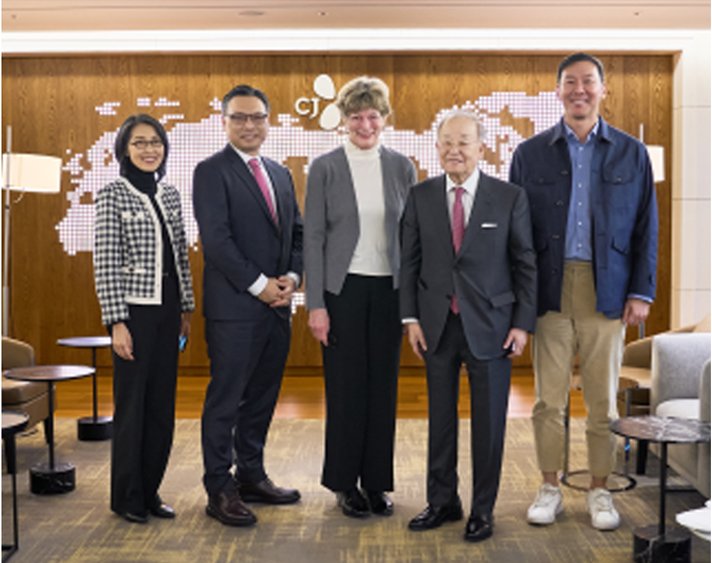
Korea Society  president Thomas Byrne, retired General Walter “Skip” Sharp, former U.S. commander in Korea, and Kathleen Stephens, former U.S. ambassador to Korea and William J. Perry Distinguished Fellow in the Korea Program at Stanford’s Shorenstein APARC , engage in discussion about the new U.S. president and political, economic and security options on Korea and East Asia.

The New U.S. President, Korea and East Asia    


TUESDAY, DECEMBER 6, 2016 | 12 PM


Philippines Conference Room
Encina Hall, 3rd Floor
616 Serra St.
Stanford, CA 94305


About the Panelists

Thomas J. Byrne joined The Korea Society as its president in 2015. He came to the Society from Moody’s Investor Services, where he was Senior Vice President, Regional Manager, Spokesperson, and Director of Analysis for the Sovereign Risk Group in the Asia-Pacific and Middle East regions. Before moving to Moody’s in 1996, he was the Senior Economist of the Asia Department at the Institute of International Finance in Washington, D.C. Byrne holds a master’s degree in international relations with an emphasis on economics from the Johns Hopkins’ School of Advanced International Studies. Before his graduate work, he served in South Korea for three years as a U.S. Peace Corps volunteer. He teaches a graduate-level course, Sovereign Risk, at Columbia University’s School of International and Public Affairs in Fall 2016.


General Walter “Skip” Sharp was commander of the United Nations Command, ROK-U.S. Combined Forces Command and U.S. Forces in Korea from 2008 to 2011. He also commanded troops in Operations Desert Shield and Desert Storm, Operation Uphold Democracy in Haiti and the Multinational Division (North) of the NATO-led Stabilization Force in Bosnia. He previously had four assignments at the Pentagon on the Joint Staff. He was the deputy director, J5 for Western Hemisphere/Global Transnational Issues; vice director, J8 for Force Structure, Resources, and Assessment; director for Strategic Plans and Policy, J5; and the director of the Joint Staff.

Born in Morgantown, West Virginia, while his father was fighting in the Korean War, General Sharp graduated from West Point in 1974 and was commissioned as an armor officer.  He earned a master’s degree in operations research and system analysis from Rensselaer Polytechnic Institute and is a graduate of the Army War College. He is consulting for and on the board of directors of several U.S. and Korean companies and The Korea Society. He is involved in Northeast Asia and especially Korea strategy and policy discussions at several think tanks in the Washington, D.C. area.


Kathleen Stephens, a former U.S. ambassador to the Republic of Korea, is the William J. Perry Distinguished Fellow in the Korea Program at Stanford’s Shorenstein Asia-Pacific Research Center. She has four decades of experience in Korean affairs, first as a Peace Corps volunteer in rural Korea in the 1970s, and in ensuing decades as a diplomat and as U.S. ambassador in Seoul. She came to Stanford previously as the 2013-14 Koret Fellow after 35 years as a foreign service officer in the U.S. Department of State.

Stephens’ diplomatic career includes chargé d’affaires to India in 2014; acting under secretary of state for public diplomacy and public affairs in 2012; U.S. ambassador to the Republic of Korea from 2008 to 2011; principal deputy assistant secretary of state for East Asian and Pacific affairs from 2005 to 2007; and deputy assistant secretary of state for European and Eurasian affairs from 2003 to 2005.


A Year in Review: Regional Politics and Security

2016 11 03  year-in-review  icon2

Pacific Forum CSIS President Ralph Cossa reflects on 2016 developments impacting Northeast Asia, from the step-up in tensions on and around the Korean Peninsula to the South China Sea, in conversation with Stephen Noerper.

A Year in Review
Regional Politics and Security


Ralph Cossa           
President, Pacific Forum CSIS in Honolulu
Senior Editor of the Forum’s quarterly electronic journal, Comparative Connections


Tickets: $10 for Members, $20 for Guests

Explorer Level and YPN Members Register Here


12:00 PM | Arrivals & Reception 
12:30 PM | Discussion


If you have any questions, please contact Nikita Desai or (212) 759-7525, ext. 355.


About the Speaker

Ralph Cossa is president of the Pacific Forum CSIS in Honolulu and senior editor of the Forum’s quarterly electronic journal, Comparative Connections. He is the primary U.S. representative and former international cochair of the ASEAN Regional Forum Experts and Eminent Persons Group, as well as a founding member and current cochair of the multinational Council for Security Cooperation in the Asia Pacific (CSCAP). He is a political/military affairs and national security specialist with more than 40 years of experience in formulating, articulating, and implementing U.S. security policy in the Asia-Pacific and Near East–South Asia regions, with a particular focus on Northeast Asia security relations. He writes a regular column for the Japan Times and is a frequent contributor to the JoongAng Ilbo and other regional newspapers and periodicals. Mr. Cossa served in the U.S. Air Force from 1966 to 1993, achieving the rank of colonel and last serving as special assistant to the commander of the U.S. Pacific Command. He previously served as deputy director for strategic studies at the National Defense University’s Institute for National Strategic Studies and earlier as a national security affairs fellow at the Hoover Institution at Stanford University. He holds a B.A. in international relations from Syracuse University, an M.B.A. from Pepperdine University, and an M.S. in strategic studies from the Defense Intelligence College. He received an honorary doctorate in international relations from the University of Cambodia for his lifetime of work in promoting peace and stability in East Asia.


Changing American Perceptions of North Korea since 1948

2016 10 25  changing-american-perception  icon

This presentation will examine how portrayals of North Korea by the U.S. government and popular media diminished the possibility of diplomatic cooperation between the United States and the Democratic People’s Republic of Korea (DPRK, North Korea) over the second half of the twentieth century.  It will specifically argue that policymakers and journalists, among other observers in U.S. society, primarily made sense of the DPRK’s often-brutal actions by describing it as either a puppet of the Soviet Union and China or as an irrational actor incapable of pragmatic dialogue.  These reductive caricatures—a product, in part, of evolving ideologies in American society related to the Cold War, foreign policy, and race—blinded policymakers to the nationalistic motives behind North Korea’s decision-making and led the general public to misunderstand events in Korea.  While analyzing how intertwined links between culture and national identity influenced American foreign policy in East Asia, this discussion thus highlights the fundamental misperceptions that so often shaped U.S. decision-making vis-à-vis the DPRK since the Korean War.

Changing American Perceptions of North Korea since 1948  

Brandon K. Gauthier           


Limited Seating Available. Register Here.


1:45 PM | Arrivals 
2:00 PM | Discussion


If you have any questions, please contact Nikita Desai or (212) 759-7525, ext. 355.


About the Speaker

Brandon K. Gauthier, PhD   completed his doctorate in Modern History at Fordham University in May 2016. Specializing in the study of the United States and East Asia, his work examines the history of U.S.-DPRK relations since 1948. Gauthier’s research specifically historicizes competing cultural and political visions of North Korea in American society and explains the process through which integrated links between culture, identity, and foreign policy shaped U.S.-DPRK diplomatic history. He has previously written for the Journal of American-East Asian Relations, the North Korea International Documentation Project, the Atlantic.com, TheJournal of East Asian Affairs, Yonsei Journal of International Studies, The Oral History Review, The Shreveport Times, and NKnews.org. He has received fellowships and grants from the U.S. Department of State, the Organization of American Historians, and Fordham University.  Gauthier has presented his scholarship at the annual conferences for the American Historical Association, the Society for Historians of American Foreign Relations, the Organization of American Historians, as well as Engage Korea’s 2014 conference at Harvard University. Additionally, a student of the Korean language, Gauthier received a Critical Language Scholarship from the United States Department of State to study Korean at Chonbuk University in the summer of 2012.


Powerplay: The Origins of the American Alliance System in Asia

2016 10 21  Power-Play  icon

Georgetown University professor and CSIS Korea chair Victor Cha discusses Powerplay, his new book that examines the evolution and importance of America’s alliances with Korea and other nations in East Asia. Cha argues that the US must maximize stability and economic progress amid Asia’s increasingly complex political landscape. In conversation with senior director Stephen Noerper. A book signing follows.

Powerplay: The Origins of the American Alliance System in Asia  

Victor D. Cha         
Author of Powerplay: The Origins of the American Alliance System in Asia
Director of Asian Studies and D.S. Song Chair in the Department of Government and School of Foreign Service, Georgetown University
Senior Adviser at the Center for Strategic and International Studies in Washington, DC


Tickets: $10 for Members, $20 for Guests

Explorer Level and YPN Members Register Here


12:00 PM | Arrivals & Reception 
12:30 PM | Discussion


If you have any questions, please contact Nikita Desai or (212) 759-7525, ext. 355.


About the Speaker

Professor Victor D. Cha (Ph.D. Columbia, MA Oxford, BA Columbia) is director of Asian Studies and holds the D.S. Song Chair in the Department of Government and School of Foreign Service at Georgetown University. In 2009, he was named as Senior Adviser at the Center for Strategic and International Studies in Washington, DC.

He left the White House in May 2007 after serving since 2004 as Director for Asian Affairs at the National Security Council. At the White House, he was responsible primarily for Japan, the Korean peninsula, Australia/New Zealand and Pacific Island nation affairs. Dr. Cha was also the Deputy Head of Delegation for the United States at the Six Party Talks in Beijing, and received two Outstanding Service commendations during his tenure at the NSC.

He is the author of five books: 1) Alignment Despite Antagonism: The United States-Korea-Japan Security Triangle (Stanford University Press) (winner of the 2000 Ohira Book Prize), 2) Nuclear North Korea: A Debate on Engagement Strategies (Columbia University Press, 2004 with Dave Kang), 3) Beyond the Final Score: The Politics of Sport in Asia (Columbia, 2009); 4) The Impossible State: North Korea, Past and Future (HarperCollins, 2012); and 5) Powerplay: Origins of the American Alliance System in Asia (Princeton University Press, forthcoming). He has written articles on international relations and East Asia in journals including Foreign Affairs, International Security, Political Science Quarterly, Survival, International Studies Quarterly, and Asian Survey. Professor Cha is a former John M. Olin National Security Fellow at Harvard University, two-time Fulbright Scholar, and Hoover National Fellow, CISAC Fellow, and William J. Perry Fellow at Stanford University. He is a Fellow (non-resident) in Human Freedom at the George W. Bush Institute in Dallas, Texas. He holds Georgetown’s Dean’s Award for teaching in 2010, the Distinguished Research Award for 2011, and the Distinguished Principal Investigator Award for 2016.

He serves as an independent consultant, and has testified before Congress on Asian security issues. He has been a guest analyst for various media including CNN, ABC Nightline, NBC Today Show, CBS Morning Show, Fox News, MSNBC, CNBC, BBC, ESPN, Sports Illustrated, and National Public Radio. He has a cameo role (as himself) in the upcoming action film “Red Dawn” (Contrafilm, MGM, Vincent Newman Entertainment) scheduled for release in November 2012.

His book, The Impossible State: North Korea, Past and Future (released April 2012 by HarperCollins Ecco), was selected by Foreign Affairs as a best book of 2012 on the Asia-Pacific. http://www.harpercollins.com/books/Impossible-State-Victor-Cha/?isbn=9780062200150

Dr. Cha is the proud parent of a 2015 White House presidential scholar and 2014 Wendy’s High School Heisman award winner.


Korea, East Asia and the US Presidential Election

2016 10 06  US-elections  icon

Mansfield Foundation president Frank Jannuzi and NCNK executive director Keith Luse, both former senior advisors to the Senate Foreign Relations Committee, discuss the positions of candidates Clinton and Trump respective to Korea and Asia with Stephen Noerper.

Korea, East Asia and the US Presidential Election  

Frank Jannuzi          
President, Mansfield Foundation

Keith Luse
Executive Director of the National Committee on North Korea (NCNK)


Tickets: $10 for Members, $20 for Guests

Explorer Level and YPN Members Register Here


12:00 PM | Arrivals & Reception 
12:30 PM | Discussion


If you have any questions, please contact Nikita Desai or (212) 759-7525, ext. 355.


About the Speakers

Frank Jannuzi is President of the Mansfield Foundation and has written extensively on East Asia policy issues, including U.S. relations with Korea, Japan and China. From 1997 until 2012, Frank Jannuzi was Senior East Asia Policy Advisor for Senators Joseph Biden and John Kerry at the US Senate Foreign Relations Committee. Jannuzi also was a Hitachi Fellow at the Council on Foreign Relations, visiting lecturer at Keio University, and a visiting scholar at Tokyo’s Institute of International Policy Studies. Frank Januzzi holds a BA from Yale University and Masters in Public Policy Harvard’s John F. Kennedy School of Government. 


Keith Luse is Executive Director of the National Committee on North Korea (NCNK). Keith Luse was the Senior East Asia Policy Advisor for Senator Richard G. Lugar at the US Senate Foreign Relations Committee from 2003 until 2013. Luse was also Staff Director for Senator Lugar at the Senate Agriculture Committee from 1999 through 2002, He is a Co-Recipient of the 2010 Kato Ryozo Award for Service to the US-Japan Alliance. Upon departing the Senate in 2013, Luse was awarded the Philippine Legion of Honor Award by President Aquino. Luse joined Senator Lugar’s Indiana Office in 1978 and was appointed State Director in 1982. He holds a graduate certificate in public management and BA from Indiana University. 


Stephen Noerper  (moderator) is Korea Society senior director, a Columbia University professor, and fellow with the Weatherhead East Asia Institute and Pacific Forum CSIS. He writes on US policy and Korea and Northeast Asia. A former State Department senior analyst, Dr. Noerper has authored more than sixty publications and appeared on Bloomberg, BBC, CNN, NHK, VOA and elsewhere. He has taught at NYU, American University, Asia-Pacific Center for Security Studies and as a visiting professor to Waseda University and the National University of Mongolia. 


Of Interest:

South Korea is a crucial U.S. partner

Don’t Undercut the U.S., South Korean Alliance

South Korea to America: Please Elect Hillary Clinton


National Assembly Speaker Chung Sye-kyun

2016 09 15  Chung-Sye-Kyun  icon3

Speaker of the Republic of Korea’s 20th National Assembly, Chung Sye-kyun, addresses current developments on the Korean Peninsula, the Korea-US alliance, and Korea’s regional and global leadership in a special address to Korea Society members and guests.

National Assembly Speaker Chung Sye-kyun   

The Honorable Chung Sye-kyun           
The Speaker of the Republic of Korea’s 20th National Assembly


Seating is by invitation and with advance confirmation.
Please contact policy “at” koreasociety.org for more information.


If you have any questions, please contact Nikita Desai or (212) 759-7525, ext. 355.


The Honorable Chung Sye-kyun's RemarksAbout the Speaker

The Evolving ROK-US Alliance and Peace in Northeast Asia

1. Introduction

Chairman Thomas C. Hubbard,
President Thomas J. Byrne,
Ladies and gentlemen,

It is my great pleasure to be given this opportunity to share my thoughts with members of the Korea Society which has been playing catalytic roles in fostering Korea-US friendship.

Last Sunday marked the 15th anniversary of the 9/11 tragedy. On behalf of the people and the National Assembly of the Republic of Korea, I’d like to pay tribute to all those who lost their lives and to the families who lost their loved ones in the terror attacks.

I would also like to offer my respect for the strength and resilience of the American people for building the One World Trade Center, ‘a new tower of hope’ built on the site of the attack.

The Korea Society, which was established under the leadership of General James A. Van Fleet in 1957, will celebrate 60 years next year. Noting its dedication and service as a bridge between our two countries throughout its long history, which almost coincides with that of the ROK-US alliance, I would like to express my deep gratitude for your efforts to enhance the bilateral relations between our two countries. I especially appreciate your meaningful and constructive programs designed to foster mutual understanding between young people in the two countries.

On a personal note, the U.S. holds a special place in my heart. After graduating from college in Korea, I worked for an international trading company. Back then, Korea, a country with scarce natural resources, was making every effort to promote international trade as a driver of economic growth. As a young businessman working in overseas offices of a Korean trading company, I spent my 30s in New York and Los Angeles.

At that time, the US was enjoying its new heyday under Reaganomics based on a strong belief in a free-market economy. The US-led global free trade system provided Korea new opportunities for growth. I also gained valuable experience of studying in the US education system and watching the dynamism of the world over the shoulder of a giant called the United States.

2. Assessment of the ROK-US Alliance

Ladies and gentlemen,

Incubated in 1953 at the end of the Korean War, the Korea-US alliance began as an unbalanced alliance. Although it was created under the unusual circumstances of the Korean Armistice, it is now considered one of the most successful alliance relationships.

The prosperity of South Korea, which has successfully transformed itself from an aid recipient to an aid donor, would have never been possible without the solid foundation of the alliance over the last 60 years or so.

Witnessing the level of development on their returning journey to Korea after many decades, those Korean War veterans said they were touched by the remarkable results of their sacrifices of putting their lives on the line.

Even in this moment, the ROK and U.S. soldiers are standing shoulder to shoulder to protect peace on the Korean Peninsula with “ready to fight tonight” spirit. The people of South Korea deeply appreciate their support and commitment.

3. Political situation of the Korean Peninsula and Northeast Asia

3-1. Political Situation on the Korean Peninsula

Ladies and gentlemen, The ROK-US alliance has contributed tremendously to maintaining peace on the Korean Peninsula. However, it is still faced with unrelenting challenges from North Korea. That is why it needs to be further solidified despite consistent and successful outcomes of our cooperation for the last 60 years.

Even in the face of UN sanctions and other international restrictions, North Korea has devoted national energy and resources into advancing its military capabilities such as nuclear weapons and missiles rather than in upgrading living standard of people. Its continued reinforcement of the armed forces and provocations has put the Korean Peninsula’s security in danger more than ever.

Its 4th nuclear test earlier this year has rightly aroused international concern. The successful test firing of SLBM or submarine launched ballistic missile) could be a game changer in the regional security dynamic.

Furthermore, just 3 days before my departure to the U.S., North Korea conducted its 5th nuclear test. With this test, it seems to have come very close to miniaturizing nuclear warheads. A North Korea equipped with nuclear attack capabilities using missiles has nearly become reality.

Cross-party leaders of the National Assembly including myself all resolutely oppose to such provocative actions and threats to peace on the Korean Peninsula and the international order. We share the view that international sanctions against such actions are inevitable.

However, the problem is that a wrong judgement or decision by North Korea with such dangerous weapons at hand might lead to devastating consequences on the Korean Peninsula. That is why the people of South Korea are deeply anxious about the increased sophistication of the North Korea’s nuclear and missile programs.

Under the circumstances, the U.S. and ROK forces are required to retain a constant combat readiness posture within the frameworks of the robust ROK-US alliance. Also, the alliance needs to show, with no uncertainty, its will and capability to respond with immediate destruction in the event of any misjudgment or miscalculation on the part of North Korea.

However, sanctions and pressures alone are difficult to resolve the North Korean nuclear issue. Its regime is more solid in terms of its survivability than it might look from outside. It should never be overlooked that even after millions of its people died from hunger, and despite international pressures and sanctions, the North Korean regime still stands today.

I have a good understanding of the background of the Obama administration’s “Strategic Patience” policy. Looking back, however, it seems that this policy has ended up giving North Korea time to advance their nuclear and missile technologies.

What I’m saying is not that sanctions are unnecessary, but that changing circumstances require a flexible approach. To jump to the conclusion, I believe that we need to take a dual track approach of using both sanctions and engagement.

3-2. Political situation in Northeast Asia

Distinguished guests,

Let us now turn our attention to Northeast Asia. Despite the global financial crisis, Northeast Asia has continued to serve as the engine of the world economy, and regional economic interdependence has been deepening at a rapid pace. However, regional security faces growing instability due to lack of trust. This is the so-called “Asia Paradox.”

Threats to peace and stability in Northeast Asia include not only the North Korea’s nuclear and missile capabilities, but also historical, territorial disputes between countries in the region as well as transnational crimes and natural disasters. With these threats continue to escalate, regional security faces growing instability.

The rising China is especially an important factor influencing the regional dynamics. China, which has undergone a remarkable evolution from the world’s factory to the world’s market, is intent on expanding its influence in East Asia based on its massive economic power.

Some people say that while Washington wants South Korea to join in its strategy of greater engagement with Asia, Seoul, being wary of Beijing, is taking a cautious approach. I will not deny that there exists such a difference in our perception. However, one thing that is clear is that the ROK-US alliance is a matter of life or death for South Korea.

That is especially true with continuing threats from North Korea. South Korea does not have the capabilities to deter against North Korea’s ever-advancing nuclear program. That is why we need to further enhance the trust between militaries of the two countries.

4. Toward peace on the Korean Peninsula and Northeast Asia

4-1. Sanctions and engagement in parallel

Ladies and gentlemen!

North Korea’s nuclear program is a fatal threat to South Korea. We cannot live with North Korea’s nuclear weapons over our heads. South Korea opposes the North’s nuclear development more decisively than any other country in the world. The matter must not be left to the whims of political strife. For South Korea, it is a matter of life and death.

South Korea, the United States, and the international community have placed strong pressure on North Korea for its wrong choices. The main purpose of sanctions against North Korea is to draw Pyongyang to the negotiating table and convince it to abandon its nuclear ambitions. But it’s not so clear whether the pressure on Pyongyang has worked well.

Despite the UN Security Council Resolution 2270, considered the toughest non-military measure against a specific country in the UN’s 70 year history, North Korea fired SLBM and conducted the 5th nuclear test. Already, three months have passed since the deadline for submitting the implementation report for the resolution. But thus far, less than a third of UN members have turned in their report.

North Korea should pay an appropriate price for its miscalculation. But it would be misguided to believe that sanctions are the answer to everything. It is also wishful thinking to see the defection of a handful of North Korean elites as a sign of regime collapse. Pyongyang has rapidly advanced its nuclear and missile capabilities, posing a challenge to the policy of “Strategic Patience.” The 5th nuclear test has reduced the average time interval between the North Korea’s nuclear tests from three years to six months.

Historically, Cuba, Iran, and Myanmar also faced international sanctions for a long time. Yet their regimes managed to survive. Regardless of whether it would happen or not, regime collapse in North Korea entails monumental challenges. And South Korea, the party with the most at stake, is not well-enough prepared for it, along with its unpredictable repercussions.

The best way forward is to exercise sanctions and engagement strategy simultaneously. While slapping sanctions on the North, the Resolution 2270 also calls for peaceful resolution of the North Korean nuclear issue through a dialogue. With sanctions in place, leverage over North Korea’s key decision-makers should be ramped up.

To this end, the Iran nuclear deal is worth looking at. The deal was reached after marathon negotiations between the P5-plus-1 and Iran. I believe that such multilateral engagement is needed to induce change in North Korea.

Seven years have passed since the Six Party Talks came to a deadlock. And over that time, North Korea has never ceased its nuclear and missile program. The consequences are now being felt. Nevertheless, I believe that the experience of the Six Party Talks will remain a valuable asset in our journey toward a peaceful Korean Peninsula.

4-2. Dialogue among parliaments of the Six Party Talks countries

Distinguished guests,

The vicious cycle of the arms race in Northeast Asia does not correspond to the long-term interests of countries in the region. Such arms race will be a stumbling block to regional cooperation and will lead to the ‘Security Paradox’ where the security environment gets worse despite the tightened security.

At this moment, the most crucial thing is to reinforce the role of diplomacy. In this regard, I felt compelled to initiate a dialogue among the parliaments of the region, particularly those from the Six Party Talks countries, in order to alleviate any security instability brought on by situations on the Korean Peninsula and Northeast Asia.

Recently, I will send a letter and proposal to the speakers of the parliaments from the Six Party Talks countries step by step. Such dialogue will complement and facilitate discussions carried out at the government level.

The final objective of the initiative is to resolve North Korea’s nuclear issues and to bring peace on the Korean Peninsula. In addition, a parliamentary dialogue will help ease tensions in the region. By broadening communication channels, it will help build up trust and present a vision of peace and shared prosperity.

When compared with ongoing government talks in the region, the parliaments can take a more flexible approach in their dialogues. Therefore, the inter-parliamentary dialogues can contribute to strengthened inter-governmental communication. In addition, the parliaments are better positioned than their governments to encourage participation and cooperation from civil society and private sector.

4-3. Korea-US alliance contributing to unification of two Koreas

Distinguished guests,

All the challenges we face, such as Pyongyang’s provocations, discord over issues surrounding the Korean Peninsula, and the U.S’s expectations of an increased South Korean role in the alliance will vanish if the two Koreas are reunified.

The U.S. has achieved several diplomatic breakthroughs in its relations with so-called rogue states which once posed serious challenges to its foreign policy. A dictatorship was put to an end in Libya, a historic deal was sealed with Iran, and diplomatic relations were normalized with Cuba. These represent some of the U.S.’s most exceptional diplomatic accomplishments.

In 2012, when President Obama visited Korea, the leaders of our two countries reaffirmed their commitment and support for a peaceful reunification of the two Koreas. Many Koreans remember the active cooperation and support that the U.S. gave in the German unification process. Koreans expect the U.S. to perform a similar role for the Korean unification.

The Berlin Wall was torn down much earlier than even experts anticipated. It happened mainly due to close diplomatic coordination between the U.S. and West Germany in convincing other stakeholders.

The Korea-U.S. alliance has been a great success. It will rise to an even higher plane if our concerted efforts can lead to reunification. Our two countries should join forces to convince neighboring countries and engage with Pyongyang, paving the path toward reunification.

5. The alliance evolves

Distinguished guests,

Looking ahead, the alliance faces three tasks.

First is to maintain a firm defense posture against North Korea’s existing threats.

Second is to encourage Pyongyang to sit at the dialogue table while pursuing engagement with the North.

Last but not least is to elevate the alliance to another level to brace it for changing situation in a unified Korea and beyond as well as new world order.

Stability on the Korean Peninsula and increased chances of reunification will enable the alliance to reach farther beyond the Korean Peninsula. We will stand shoulder to shoulder as equal partners to share our responsibilities in addressing common international challenges.

Recently, we listened closely to the voices of ordinary American voters in the hotly contested presidential campaign. Korea will play its role as a mature and equal partner with the U.S. I’m confident that our enduring alliance will keep moving forward in a spirit of mutually respectful communication not in a one-way communication.

In the past, Korea underwent two major turns of fate when the U.S. scaled down its focus on the Korean Peninsula. Therefore, if the United States shifts its gear toward isolation policy in place of engagement policy on the Korean Peninsula and in East Asia, it definitely would be a big concern for the Korean people. I firmly believe that staying engaged in East Asia and fostering the forward-looking Korea-U.S. alliance serve the national interests of the U.S. as well as that of Korea.

6. Conclusion

Distinguished guests,

Although Europe experienced two World Wars, it established the regional economic community and now is developing into the regional political community. In spite of the deep historical wound, mutual understanding and cooperation have created the European Union.

However, Northeast Asia is still in the middle of the Cold War order and is at a new crisis point. But every crisis presents an opportunity. The region will assume a vital role in promoting global peace and shared prosperity in the 21st century.

To this end, I believe that the inter-parliamentary dialogue I have proposed will generate meaningful progress in overcoming the Asia Paradox, resolving North Korea’s nuclear issue, and nurturing peace in the region.

If the initiative is to become a success, it should be underpinned by a strong ROK-U.S. alliance. Let me close by stressing that the Korea-U.S. alliance should aim higher than a security alliance and economic alliance in order to become an alliance for global values.

Once again, I thank Chairman Thomas Hubbard, President Thomas J. Byrne, and the members of the Korea Society for giving me this great opportunity.

Thank you.

 

The Honorable Chung Sye-kyun was elected Speaker of the 20th National Assembly of the Republic of Korea in June. He entered public service in 1996, when he was elected to the National Assembly. Dr. Chung served recently as a member of the Foreign Affairs and Unification Committee and was previously Chairman of the Special Committee on Reforms of the National Intelligence Service (NIS). Speaker Chung held key party posts, including chief of planning and policy coordination during the 2002 presidential campaign of Roh Moo-hyun. He served as Minister of Commerce, Industry and Energy and later Chairman of the Uri Party and then Democratic Party. Speaker Chung earned a Ph.D. in Business Administration from Kyung Hee University, an MBA from Pepperdine University, and a BA in Law from Korea University.


Security Challenges on the Korean Peninsula

2016 09 12  security-challenges  icon

Ha Young-sun, chairman of the board of the East Asia Institute; Chun Chaesung, chair of EAI’s Asia Security Initiative Research Center; and Sohn Yul, dean and professor of the Graduate School of International Studies at Yonsei University; address inter-Korean tensions and South Korea’s security concerns in a panel discussion moderated by senior director Stephen Noerper.

Security Challenges on the Korean Peninsula  

Ha Young-sun           
Chairman of the board of the East Asia Institute

Chun Chaesung            
Chair of EAI’s Asia Security Initiative Research Center

Sohn Yul            
Dean and professor of the Graduate School of International Studies at Yonsei University


Advanced Registration Required for Admission. Please  Register Here.


3:30 PM | Arrivals 
4:00 PM | Discussion


If you have any questions, please contact Nikita Desai or (212) 759-7525, ext. 355.


About the Speakers

HA Young Sun is Chairman of the board of trustees at the East Asia Institute. He is also a professor emeritus of the department of political science and international relations at Seoul National University. Currently, Dr. Ha is serving as a member of the Presidential National Security Advisory Group and the Presidential Committee for Unification Preparation. He was the Co-chairman of Korea-Japan Joint Research Project for New Era, the Director of the Center for International Studies and American Studies Institute at Seoul National University, the President of the Korea Peace Studies Association, and a research fellow at the Center for International Studies at Princeton University, and the Stockholm International Peace Research Institute in Stockholm. He received his B.A. and M.A. from Seoul National University, and holds a Ph.D. in international politics from the University of Washington. His recent books and edited volumes include: Korean Peninsula among Big Powers 1972 vs 2014 (2015) Trustpolitik 2.0 on the Korean Peninsula: Complex Policy of Deterrence, Engagement, and Trust(2014), Toward 2020: Ten Agendas for South Korea’s Foreign Policy (2013), A New Era for Korea-Japan Relations: Seven Tasks for Bilateral Cooperation (2013),Young-Sun Ha on International Politics: A Collection of Columns from 1991 to 2011 (2012), The History of Social Science Concepts in Modern Korea I & II (2009 /2012), Complex World Politics: Strategies, Principles, and a New Order (2012), Young Pioneers in Korean History (2011), The Future of North Korea 2032: The Strategy of Coevolution for the Advancement (2010), The Emergence of Complex Alliances in the 21st Century (2010), and A New Era of Complex Networks in Korea-Japan Relations (2010).

Chun Chaesung is the Chair of the Asia Security Initiative Research Center at East Asia Institute. He is a professor of the department of political science and international relations at Seoul National University and director of Center for International Studies at Seoul National University. Dr. Chun is also serving as a member of Presidential Committee for Unification Preparation and as an advisory committee member for the Republic of Korea Ministry of Foreign Affairs and the Ministry of Unification. He received his B.A. and M.A. from Seoul National University, and Ph.D. in international relations from Northwestern University. His research interests include international relations, security studies, South Korean foreign policy, and East Asian security relations. His recent publications include Is Politics Moral? Reinhold Niebuhr’s Transcendental Realism (2012), Theory of East Asian International Relations (2011), and “The Rise of New Powers and the Responding Strategies of Other Countries” (2008).

Sohn Yul is Dean and Professor of the Graduate School of International Studies at Yonsei University, Seoul, Korea. Before joining at Yonsei, he taught at Chung-Ang University, Seoul, Korea, and was a visiting scholar at institutions in the University of Tokyo, Waseda University, and the University of North Carolina at Chapel Hill. Currently, Sohn serves a number of government advisory committees including the Ministry of Foreign Affairs, Korea National Diplomacy Academy, and the Northeast Asian History Foundation. He also has served President of the Korean Studies of Contemporary Japan. He has written extensively on Japanese and East Asian political economy, East Asian regionalism, and global governance. His most recent publications include “Attracting the Neighbors: Soft Power Competition in East Asia,” “Securitizing Trade: The Case of U.S.-Korea FTA,” and “Japan’s New Regionalism: China Threat, Universal Values, and the East Asian Community.” Sohn received his Ph.D. in Political Science from the University of Chicago, Illinois, USA.


Next Steps in Korea-Japan Relations


2016 09 08  korea-japan-relation  icon2

Pacific Forum CSIS executive director Brad Glosserman and Council on Foreign Relations fellow and director Scott Snyder, authors of The Japan-South Korea Identity Clash, address progress and potential in Korea-Japan relations in a session co-presented with the Japan Society. North Korea has conducted a fourth nuclear test, a long range missile test and multiple intermediate and short range missile launches this year. As a result, South Korea and Japan have accelerated their cooperation bilaterally, and trilaterally with the United States. The logjam of blocked Korea-Japan relations given territorial and historical memory disputes appears to have given way to the necessity for and practicality of security cooperation. However, this process has been slower and more fitful than many expected. Despite their proximity, their deeply intertwined histories and the convergence of many interests, there are considerable misperceptions in each country about the other. Glosserman and Snyder root many of these problems in the competing sense of national identity in each country. Glosserman and Snyder opine on constraints and opportunities, as well as shared concerns over North Korea’s provocations and China’s growing reach.

Next Steps in Korea-Japan Relations

Brad Glosserman          
Executive Director of the Pacific Forum CSIS in Honolulu

Scott Snyder             
Senior fellow for Korea studies and director of the program on U.S.-Korea policy at the Council on Foreign Relations (CFR)


The Korea Society and Japan Society  Member Tickets: $15 

Non-Member Tickets: $20

Explorer, YPN and above attend this program for FREE with RSVP


12:00 PM | Arrivals & Registration 
12:30 PM | Discussion


If you have any questions, please contact Nikita Desai or (212) 759-7525, ext. 355.


About the Speakers

Brad Glosserman is Executive Director of the Pacific Forum CSIS in Honolulu, a nonprofit, foreign policy research institute affiliated with the Center for Strategic and International Affairs (CSIS) in Washington, D.C. The Pacific Forum has provided policy-oriented analysis and promoted dialogue on regional security, political, economic and environmental issues in the Asia-Pacific region since 1975. He oversees all aspects of Pacific Forum activities.

Mr. Glosserman is co-editor of Comparative Connections, the Pacific Forum’s triennial electronic journal, and writes, along with Pacific Forum President Ralph Cossa, the regional review. He is the author of dozens of monographs on U.S. foreign policy and Asian security relations and other articles have appeared in scholarly journals throughout the region, along with numerous chapters to books on regional security. The Japan-South Korea Identity Clash, his study (with Scott Snyder) of national identity in Japan and South Korea and its impact on US alliances was published by Columbia University Press in May 2015, and he recently completed a study (with Carl Baker) on the future of US alliances in Asia. He is wrapping up a manuscript on the impact of the March 11, 2011 “triple catastrophe” on Japan. He is the editor (with Tae-hyo Kim) of The Future of U.S.-Korea-Japan Relations: Balancing Values and Interests (CSIS Press 2004). His opinion articles and commentary regularly appear in media around the globe. He is a frequent participant in US State Department visiting lecture programs and speaks at conferences, research institutes and universities around the world. He is also the English-language editor of the journal of the New Asia Research Institute (NARI) in Seoul.

Prior to joining Pacific Forum, Mr. Glosserman was, for 10 years, a member of The Japan Times editorial board, and he continues to serve as a contributing editor for the newspaper. He periodically lectures at the Management Center of Innsbruck (MCI). Mr. Glosserman has a JD from George Washington University, an MA from Johns Hopkins University’s School of Advanced International Studies (SAIS) and a BA from Reed College.


Scott Snyder is senior fellow for Korea studies and director of the program on U.S.-Korea policy at the Council on Foreign Relations (CFR), where he had served as an adjunct fellow from 2008 to 2011. Prior to joining CFR, Snyder was a senior associate in the international relations program of The Asia Foundation, where he founded and directed the Center for U.S.-Korea Policy and served as The Asia Foundation’s representative in Korea (2000-2004). He was also a senior associate at Pacific Forum CSIS. Snyder has worked as an Asia specialist in the research and studies program of the U.S. Institute of Peace and as acting director of Asia Society’s contemporary affairs program.  Snyder was a Pantech visiting fellow at Stanford University’s Shorenstein Asia-Pacific Research Center during 2005–2006, and received an Abe fellowship, administered by the Social Sciences Research Council, in 1998–99. He has provided advice to NGOs and humanitarian organizations active in North Korea and serves as co-chair of the advisory council of the National Committee on North Korea.

Snyder has authored numerous book chapters on aspects of Korean politics and foreign policy and Asian regionalism and is the author of The Japan-South Korea Identity Clash: East Asian Security and the United States (with Brad Glosserman, 2015), China’s Rise and the Two Koreas: Politics, Economics, Security (2009), Paved With Good Intentions: The NGO Experience in North Korea (co-editor, 2003), and Negotiating on the Edge: North Korean Negotiating Behavior (1999).

Snyder is the co-editor of North Korea in Transition: Politics, Economy, and Society (Rowman and Littlefield, October 2012), and the editor of Middle-Power Korea:Contributions to the Global Agenda (Council on Foreign Relations, June 2015), Global Korea: South Korea’s Contributions to International Security (Council on Foreign Relations, October 2012) and The U.S.-South Korea Alliance: Meeting New Security Challenges (Lynne Rienner Publishers, March 2012). He served as the project director for CFR’s Independent Task Force on policy toward the Korean Peninsula. He currently writes for the blog, “Asia Unbound.”

Snyder received a BA from Rice University and an MA from the regional studies East Asia program at Harvard University and was a Thomas G. Watson fellow at Yonsei University in South Korea.


Of Interest:


Defense white paper looks at N. Korea missiles, China intrusions

Japan, South Korea inch towards better bilateral ties


 Co-organized with:

 2016 03 03  korea-japan-relations  JPS-logo


National Korean War Veterans Armistice Day Memorial Ceremony

2016 07 27  Armistice-Day  icon2

JULY 25, 2016  — NEW YORK — The Korea Society, a 59-year-old organization that promotes awareness, understanding and cooperation between the United States and Korea, hosted a memorial ceremony for veterans of the Korean War on Wednesday, July 27, 2016, at noon at the New York Korean War Veterans Memorial in Battery Park in lower Manhattan. The event, which marked the 63rd anniversary of the signing of the Korean War Armistice Agreement, was organized in collaboration with the Global Society of Korea and America, a nonprofit organization that promotes good relations between Korea, the Korean-American community, and the United States.

The 40-minute ceremony commenced with the presentation of the colors by the New York State Veteran Corps of Artillery, followed by the singing of the national anthems of the Republic of Korea and the United States by a Juilliard student. Thomas J. Byrne, President of The Korea Society, welcomed the guests and Ambassador Gheehwan Kim, Consul General of the Republic of Korea in New York, provided the memorial address to veterans who are members of the Korean Veterans Association, Northeast Region; the Corporal Kivilehan Chapter #66 of Staten Island; and the Korean War Veterans Association Central Long Island Chapter #6.

Remarks were also given by Korean War veteran Salvatore Scarlato, President of the New York Department of the Korean War Veterans Association, and a memorial prayer was said by Father Samuel Kim, Prior of St. Paul’s Abbey, Newton, N.J. This Benedictine monastery was home to Brother Marinus Leonard LaRue, the late merchant marine captain who in the Korean War evacuated 14,000 refugees from Hungnam, North Korea, in what has been called one of the greatest rescues by a single ship in maritime history. The ceremony concluded with the playing of taps by a West Point bugler and the retiring of the colors.

“It is important to honor the sacrifices our veterans make for the protection of the free world,” said Thomas Byrne, Korea Society President. “As we commemorate the anniversary of the armistice ending the Korean War, it is imperative to remember the importance of our special relationship with South Korea. U.S.-South Korean military, economic, and people-to-people relations today are broader, deeper, and stronger than ever.”

“Many in the vibrant Korean-American community would not be here today without the sacrifice of the South Korean and American veterans, as well as those from 20 other member nations of the United Nations who had committed themselves to support South Korea,” said Henry Kang, President of the Global Society of Korea and America.

“The United States entered the Korean War to preserve liberty and democracy in the world, and our commitment to the Korea still stands today,” said Korean War veteran Salvatore Scarlato.


REMARKS

Thomas J. ByrneAmb. Gheewhan KimHenry KangFr. KimProclamation

Thomas J. Byrne
President
The Korea Society


The Korea Society a 59-year-old organization that promotes awareness, understanding and cooperation between the United States and Korea, is honored to host, along with the Global Society of Korea and America, this memorial ceremony for veterans of the Korean War. Today marks the 63rd anniversary of the signing of the Korean War Armistice, which ended hostilities in 1953.

We are grateful for the participation of the consulate of the Republic of Korea in New York City; the New York State Veteran Corps of Artillery; the New York Department of the Korean Veterans Association, Northeast Region; the Corporal Kivilehan Chapter of Staten Island and the Korean War Veterans Association Central Long Island Chapter. We also thank the Juilliard School, the West Point Hellcats band, and Father Samuel Kim, Prior of St. Paul’s Benedictine Abbey in Newton, N.J.

This Benedictine monastery was home to Brother Marinus Leonard LaRue, the late merchant marine captain who in the Korean War evacuated 14,000 refugees from Hungnam, North Korea, in what has been called one of the greatest rescues by a single ship in maritime history.

It is important to honor the sacrifices our veterans make for the protection of the free world. We should never forget the commitment made by veterans of 21 countries from the United Nations and those veterans from South Korea, who held three-quarters of the front line in the year before the armistice.

President Obama in his National Korean War Veterans Armistice Day Proclamation noted that “nearly 1.8 million Americans joined in the fight and faced down communism.” They helped to provide the Republic of Korea with a new birth of freedom, democracy and prosperity.

As we commemorate National Korean War Veterans Armistice Day, it is important to note that while the armistice ceased hostilities, it did not achieve, as the language of the document recommended to the governments concerned, a “final peaceful settlement.” Peaceful relations on the Korean peninsula not only remain elusive, but are under the cloud of a heightened threat from North Korea. It is, therefore, imperative to remember the importance of our special relationship with South Korea.

For more than six decades, the U.S.-ROK alliance has served as an anchor of stability and prosperity on the Korean Peninsula and in the Asia-Pacific region. This is possible because U.S.-South Korean military, economic and people-to-people relations today are broader, deeper, and stronger than ever.


Amb. Gheewhan Kim
Republic of Korea Consul General to New York


I am pleased and honored to commemorate the 63rd Korean War Armistice Day with you here at Battery Park. I thank the Korea Society and New York Korean War Veterans Association for preparing the event today.

Today 63 years ago was the day the Korean War ended. The Korean War was one of the most fierce wars that claimed 178,566 lives and wounded 555,022 soldiers from Korea, the United States and 15 other participating countries. Civilian causalities near 4 million in the course of 3-year warfare.

Taking this opportunity, I thank 900,000 Korean soldiers and 1.95 million multinational soldiers under the United Nations flag for their services and sacrifices. Without them, Korea today would not exist. Also, my thanks go to 10 million Korean and American veterans, who served to defend Korea, and 3.5 million US soldiers who were stationed in Korea after the Korean War Armistice in 1953.

Thanks to you all, Korea has been transformed in 63 years into a mature democracy and 11th largest economy in the world. Korea and the United States has been and remain the strongest allies, defending together shared values of freedom, human rights, rule of law, and market economy.

Again, North Korea is currently posing nuclear and missile threats. This is a provocation not only to Korea, but also to the whole region of Asia-Pacific. North Korea is misguided by young leader, Kim Jongun, to pursue nuclear weapons for the regime’s security, leaving North Korean people starving and suffering in miserable conditions.

North Korea cannot continue taking this horrible and isolated path. It needs to turn back, give up nuclear weapons and open up to new opportunities of peace and prosperity together.

Korea, the United States, and International Community are pressing North Korea hard with sanctions, which are strong and unprecedented. China and Russia have also joined implementing these strong sanctions.

Denuclearization of North Korea would not be an easy task, but I am sure this process will be all the more worthwhile, because this will help to avoid the scourge of nuclear war and to bring meaningful dialogue on peace and unification eventually. Along this path, the services and sacrifices of Korean War veterans will be remembered as evidence of strong alliance and partnership between Korea and the United States.

Once again, thank you, Korean War veterans. I wish you all good health and happiness. Thank you.


Henry Kang
President
Global Society of Korea and America


Thanks to Ambassador Kim Gheewhan, Mr. Thomas Byrne, Father Samuel Kim, Honor Guards, Soloist Seiyoung Kim, Bugler Sergeant Jeremy Wissner and all of our distinguished guests!

And special kudos to my dear friend, Korean War Veteran Sal Scarlato and all his fellow Korean War Veterans!

On behalf of the Global Society of Korea and America, it is our great honor to be a part of the 63rd National Korean War Veterans Armistice Day commemoration ceremony.

When the Korean War broke out, I was a 10-year-old boy, so I clearly remember you. I was among the tens of millions of Korean people who owe you their lives. How can I find the words to express the enormous gratitude I and my fellow Koreans have for your sacrifice?

As young men, you came to rescue the people whom you had never met and brought them a victory and freedom.

On the foundation of your sacrifice and the continued Alliance, Korea has become one of the world’s largest economies and a vibrant democracy. And, the Korean-American community in the U. S. is thriving and keeping pace with mainstream.

Today, at this time of increasing threats from North Korea, we all stand in front of the Korean War Veterans Memorial. Don’t we all see the brilliant sun rays shining through on the soldier’s head and illuminating the plaque of the monument?

Isn’t it a light of hope for Korea’s peaceful unification and prosperity that transcends hatred and conflict?

Let us remember the last words of a dying soldier:- “You all the living! Your today is the life that I so eagerly wanted to live. Never let my death be fruitless nor a vain sacrifice.”

Let us all together consolidate and dedicate our awakening efforts to his and all other sacrificed soldiers’ unfinished works!

Now is the time.

God bless America and Korea!

God bless you all!

Thank you!


Comments and memorial prayer by Fr. Samuel Kim, prior of St. Paul’s Abbey


Good afternoon. My name is Fr. Samuel Kim. I am a Benedictine monk at St. Paul’s Abbey. Thank you for your invitation to attend this memorial event and to the veterans of the Korean War.

I would like to tell you about our brother, Marinus LaRueu. During the Korean War, he was Captain Leonard LaRue of the merchant ship, SS Meredith Victory. In December of 1950, in the Heungnam evacuation, he took 14,000 Korean civilian refugees aboard his ship and transported them to South Korea. During the three-day journey, five babies were delivered by the first mate. Despite the hazardous conditions, frigid weather, and overcrowding, no one suffered injury or death.

After the war, in 1954, Leonard LaRue joined the missionary Benedictines at St. Paul’s Abbey, where he died peacefully in 2001. I truly appreciate the humanitarian act performed by Brother Marinus and his crew. During the Korean war, I know many other acts of courage and kindness were done to help the people of Korea. So today I want to express my gratitude to all of you, the veterans, for your hard work and the sacrifices you made for Korea. As a Benedictine monk, I will pray for you and your loved ones. Thank you.

Let us pray.

O Lord, we thank You for the sacrifices our Korean War Veterans made for us and for peace. We gather here to commemorate and honor those who unselfishly served in order to give South Koreans liberty and assure greater freedom in our world. We humbly ask You to bless the men and women of our military today and all people who seek Your perfect kingdom, where no sword is drawn but the sword of righteousness, and no strength is known but the strength of love. Guide us on the path to unity and harmony. Protect the United States of America and Korea at this time when there is so much discord and unrest in our world. In Your mercy, grant that all the nations of the world may be united in fellowship for the promotion of Your glory and the good of all mankind.

Amen.


NATIONAL KOREAN WAR VETERANS ARMISTICE DAY, 2016
BY THE PRESIDENT OF THE UNITED STATES OF AMERICA

A PROCLAMATION

In 1950, when Communist armies from the North stormed across the 38th parallel, brave American men and women though weary of combat in the wake of World War II stepped forward to defend their brothers and sisters on the Korean Peninsula. Over the course of 3 years, through unforgiving weather and severe danger, nearly 1.8 million Americans joined in the fight and faced down Communism pushing the invading armies back and protecting a people on the other side of the world. As we mark the 63rd anniversary of the Military Armistice Agreement that brought an end to this war, we pause to honor the strength and resilience of our Korean War veterans, whose spirits and stories serve as an inspiration to continue advancing freedom’s cause.

Rising from occupation and ruin, the Republic of Korea today shines as a thriving, modern country, whose people can take comfort in knowing that the commitment of the United States to their stability and security will never waver. Fifty million South Koreans now live in freedom, reaching for their dreams and pursuing opportunities in a vibrant democracy and dynamic economy always realizing they have a partner who will stand shoulder-to-shoulder with them in defense of peace and prosperity. Our lasting friendship and unbreakable alliance are sustained by the beliefs we hold in common and the values we cherish.

As we pay tribute to the Americans who gallantly helped forge this bond, we know our solemn responsibilities to our fallen and their loved ones persist long after the battle ends. More than 7,800 Americans are still missing from the Korean War, and we will not stop working to live up to our obligations to their families. We owe all our service members an enormous debt of gratitude. To honor the full weight of the sacrifices made by those who serve, we must uphold our Nation’s promise to our veterans when they return home, and fulfill our commitment to all who wear the uniform in our name.

On National Korean War Veterans Armistice Day, we pay tribute to the American patriots who fought for freedom and democracy throughout the Korean War, leaving behind everyone they loved to secure the blessings of liberty for a country they never knew and a people they had never met. For the heavy price they paid, we will forever honor the legacy of their service and uphold the ideals they secured through this hard-won victory. NOW, THEREFORE, I, BARACK OBAMA, President of the United States of America, by virtue of the authority vested in me by the Constitution and the laws of the United States, do hereby proclaim July 27, 2016, as National Korean War Veterans Armistice Day. I call upon all Americans to observe this day with appropriate ceremonies and activities that honor our distinguished Korean War veterans.

IN WITNESS WHEREOF, I have hereunto set my hand this twenty-fifth day of July, in the year of our Lord two thousand sixteen, and of the Independence of the United States of America the two hundred and forty-first.

BARACK OBAMA


Special Roundtable on Korea and the US Presidential Campaigns

2016 07 25  roundtable  icon

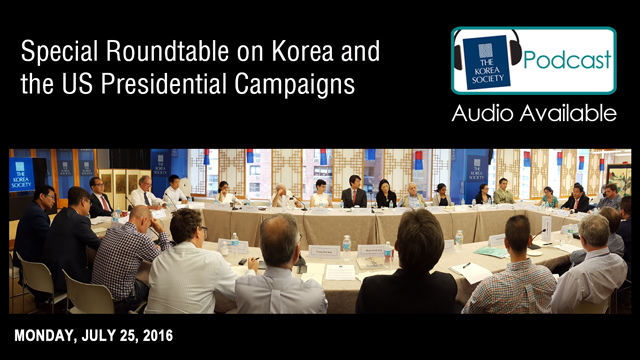
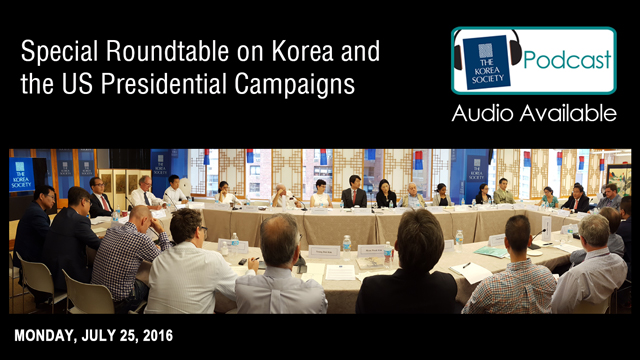
In July 25, 2016 – The general theme of the round table will be Korea, the US Presidential Campaigns, and Rising Tensions on the Peninsula.

We welcome Sang Sin LEE, a research fellow from the Korea Institute for National Unification; the Hon. Jin PARK, President. Asia Future Institute; President Jinwook CHOI of the Korea Institute for National Unification (KINU); and Professor Hyun-Wook KIM of the Korea National Diplomatic Academy.

Dr. Jin Park will speak to Korea and the Clinton and Trump campaigns, President Choi to ROK policy toward the DPRK, Professor Kim to ROK-US relations, and Dr. Lee to ROK public perceptions of North Korea.

Special Roundtable on Korea and the US Presidential Campaigns 

Sang Sin Lee        
A research fellow from the Korea Institute for National Unification

Hon. Jin Park        
President, Asia Future Institute

Jinwook Choi       
President, Korea Institute for National Unification (KINU)

Hyun-Wook Kim   
Professor, Korea National Diplomatic Academy


If you have any questions, please contact Nikita Desai or (212) 759-7525, ext. 355.